
“So God created mankind in his own image, in the image of God he created them; male and female he created them.”Genesis 1:27
Bookstores are filled with books promising a better life. We read about leadership, productivity, influence, success, relationships, purpose, and personal growth. The desire to improve ourselves is nearly universal.
Yet beneath every effort at self-improvement lies a deeper question that is rarely asked:
Who exactly is the person being improved?
Before we can know where we are going, we must understand who we are. Before we can discover our purpose, we must understand our identity. Before we can improve ourselves, we must answer one of life's most fundamental questions:
Who am I?
Most people answer that question through achievements, relationships, possessions, careers, or personal beliefs. Scripture begins somewhere entirely different. It begins with God.
At the beginning of this journey together, we marveled at the truth that we are created in the image of God. Genesis 1:27 declares it plainly: “So God created mankind in his own image, in the image of God he created them; male and female he created them.”
This alone is breathtaking. But Scripture reveals even deeper wonder and greater implications for our lives—especially as we consider our role in the Kingdom of God.
Not only are we made in His image, but we are crowned with majesty and glory. Psalm 8:5 tells us that God has made us “a little lower than the angels and crowned [us] with glory and honor.”
This honor will eventually carry real authority for those in Christ: we will one day judge angels (1 Corinthians 6:3).
Yet even this remarkable privilege points to something even more astonishing about the way God has designed us. Angels, as magnificent as they are, are created servants. They do not create other angels. They cannot bring forth new life that bears the image of God.
Yet this is exactly what you and I can do. God has given humanity—unlike the angels—the remarkable ability to bring forth new life. Every child conceived, whether in the beauty of covenant marriage or in the brokenness of human failure, is still formed by God’s sovereign hand.
He alone knits each one together in the womb (Psalm 139:13) and grants them a living spirit, an innate awareness of their Creator (Romans 1:20), and the potential to be filled with the Holy Spirit.
Every baby born is not merely a physical being, but a spiritual being with eternal destiny. In this sacred act, we reflect the creative heart of our Father in a way that even the angels cannot.
This is part of the profound purpose for which you were made. You are not an accident or a mere bystander in God’s story. Though our sin nature has separated us from our Creator, in Christ we are welcomed home as sons and daughters of the King—redeemed and designed to reflect His glory, to create life that can know and love Him, and to one day reign with Him in His eternal Kingdom. What an honor! What a calling!
The next question is: what God do you believe in?
What God Do You Believe In?
"We proclaim to you what we have seen and heard, so that you also may have fellowship with us. And our fellowship is with the Father and with his Son, Jesus Christ."1 John 1:3
It is entirely possible to say, “I believe in God,” and yet be speaking of something very different from the God of Scripture. For some, God is a force—something like energy woven into nature. For others, He is an abstract idea, the essence of humanity or the highest expression of what we value. Some picture Him as a distant Creator who set the universe in motion and then stepped back, never to engage again. Others, perhaps without realizing it, reshape God into a reflection of their own thoughts and ideals.
In each of these, God is acknowledged, but He is not truly known. He remains impersonal—something to consider, not Someone to encounter. And because of that, this kind of belief rarely changes anything. It may shape opinions, but it does not reshape a life.
A personal God is something altogether different—and this is exactly how the Bible presents Him. God is not an abstract idea or distant force. He is a personal being. He thinks. He possesses intellect. He chooses and acts according to His will. He relates, communicates, and engages with His creation. He moves within history, not outside of it.
This is not personality in the limited, human sense. It is something far greater—true personhood. It means that God is not merely to be studied or defined. He is a God who can be known.
This is where the distinction between an impersonal God and a personal God begins to matter in a very real way. If God is impersonal, then relationship is an illusion. There is no one to know, no one to respond to, and no one to whom we are accountable. Meaning becomes fragile, resting on human opinion rather than anything fixed or true. In the end, we are reduced to nothing more than physical existence—blood, bone, and tissue—living for a moment and then gone. Even prayer, in that framework, loses its meaning. It becomes words spoken into silence.
But if God is personal, everything shifts. You are no longer left to wonder in the abstract—you can know Him. Truth is no longer something we invent; it is grounded in His character. And that character is not hidden. It has been revealed. Your life is no longer without direction; it is tied to His will. He is sovereign, and we are accountable to Him.
In other words, once you move from the idea of God to the reality of a personal God, everything changes.
A Personal God
Why does it matter whether God is personal?
At first glance, the question may seem abstract or philosophical, but it reaches into nearly every part of life. The way we understand God ultimately shapes the way we understand ourselves. It influences how we think about truth, love, purpose, morality, and even our own worth.
Francis Schaeffer spent much of his life helping people think carefully about these questions. One of his most important observations was surprisingly simple: every worldview begins somewhere. Every person, whether religious or not, eventually arrives at a set of beliefs about what is ultimately real. The question is whether the foundation of reality is personal or impersonal.
Many modern explanations of the universe begin with an impersonal foundation. Matter, energy, natural laws, and physical processes are viewed as the ultimate reality from which everything else has emerged. In that view, human beings are the result of a long chain of natural events. Personality, reason, morality, love, and purpose appear later as products of that process.
Yet when we step back and observe human experience, something interesting emerges. The things that matter most to us are not impersonal things. We care deeply about love, truth, justice, beauty, meaning, and relationships. We recognize kindness as better than cruelty. We admire courage, honesty, sacrifice, and compassion. We instinctively believe that human life possesses value and dignity.
Schaeffer encouraged people to follow an idea to its logical conclusion. If reality is ultimately impersonal, where do these deeply personal realities come from? How does purpose arise from a universe that has no purpose? How does objective meaning emerge from a process that has no intention? Why should love be regarded as something noble rather than merely useful?
These questions do not prove God exists, but they do point us toward something important. The realities we treasure most—love, reason, morality, meaning, and human dignity—are personal in nature. They fit naturally within a universe created by a personal God.
Scripture begins with exactly that foundation.
Before there was a universe, there was God. Before there was matter, energy, space, or time, there was One who knew, loved, chose, communicated, and created. Personality did not emerge from creation; personality existed before creation because it existed in the Creator.
This helps explain why human beings are unlike anything else in the physical world. We are not merely biological organisms. We are image-bearers. Our capacity to reason, to create, to communicate, to love, and to seek meaning reflects something of the One who made us.
It also explains why Scripture places such value on every human life. Human worth is not determined by intelligence, appearance, wealth, social status, ability, or achievement. It is not something earned through performance. It is something bestowed by God. Every person possesses inherent dignity because every person bears the image of the Creator.
Love itself becomes easier to understand within this framework. The Bible does not present love as something humanity invented. It presents love as something we reflect. As Scripture says, "We love because He first loved us" (1 John 4:19). Love is not merely a biological mechanism or a survival strategy. It is rooted in the character of a personal God whose nature is love.
This understanding changes the way we answer the question, "Who am I?"
If ultimate reality is impersonal, identity ultimately becomes something we must create for ourselves. We spend our lives searching for meaning, value, and purpose, hoping to discover something solid on which to stand.
But if a personal Creator exists, identity is not something we invent. It is something we discover. Our worth is not self-defined. Our purpose is not self-assigned. The One who created us has already spoken to these questions.
That is why the difference between a personal God and an impersonal universe is far more than an intellectual debate. It affects how we understand ourselves, how we value others, and how we make sense of the world around us.
And if God truly is personal, the next question naturally follows:
Can He be known?
How We Know a Personal God
We know God because He has made Himself known. We are not left to search in the dark or piece Him together through speculation. God has spoken first. He has revealed Himself through His creation—in what has been made. He has revealed Himself in Scripture—in what He has said. And He has revealed Himself most clearly in Jesus Christ—in who He is.
In Christ, we begin to see God’s nature in a way we can grasp. We see His character, His compassion, His authority, and His purpose. We also begin to understand something about ourselves—what it means to be made in His image, and what God intended from the beginning. When He created Adam, His design was not distance, but fellowship. Not isolation, but relationship. We were created to walk with Him and to live in faithful stewardship of what He has made.
So knowing God is not a matter of guessing or constructing ideas. It is a response to what He has already revealed.
Knowing God is also not merely an intellectual exercise. A person can study theology, memorize Scripture, and still remain distant. Information alone does not bring relationship. To truly know a personal God means engaging Him as a living Person, not as a concept to be understood.
As that relationship grows, what is true about God begins to take shape in you—in your faith, in your trust, and in the way you see your life. You begin to recognize His sovereignty not in theory, but in the ordinary moments—in each day, each decision, even each breath. Knowing God becomes an ongoing interaction, not something reserved for study or for moments of desperation.
It is the difference between knowing facts about someone and actually knowing them. You may know when a person was born. You may read their story. But that kind of knowledge is very different from the relationship between a parent and a child—walking together, caring, interacting, sharing life. That kind of knowing goes far beyond information. It is personal, continuous, and real.
The experience of knowing God is real. It is not something confined to a Sunday morning or reduced to doctrine on a page. It is truth—something that can be lived and experienced. Not in a mystical or distant way, but in the reality of everyday life.
God’s presence is not abstract. It can be known in the ordinary rhythms of life. Prayer becomes more than a ritual; it becomes real communication. As we live under His sovereignty, obedience begins to shape us. Change takes place—not just inwardly, but in ways that can be seen.
Through faith in Christ, the Holy Spirit works within us, producing a transformation that would not be possible on our own. Character is formed. Life is redirected. What emerges is something real and lasting—the fruit of a relationship lived moment by moment with God.
Our Living Connection to God
Jesus promised that the Holy Spirit would dwell within us, not just as a concept but as a living presence who teaches, reminds, and reveals truth (John 14:26; John 16:13).
The Spirit is not distant. He intercedes when we struggle to pray (Romans 8:26), confirms our identity as God’s children (Romans 8:16), and gives us direct access to the Father (Ephesians 2:18). Through Him, we experience a relationship with God that is personal, intimate, and continual.
As we walk by the Spirit, we are led away from the chaos of self-centered living into a life marked by love, peace, and purpose (Galatians 5:16, 22–23). He is the One who makes our relationship with God real—not theoretical—and empowers us to live as image-bearers who reflect God’s character in a broken world.
The Holy Spirit is not just a doctrine; He is the vital link between belief and transformation. Through Him, we are reminded that our identity is not only defined by God—it is sustained by His presence within us.
The New Creation: Who Am I In Christ?
This brings us to the most personal and beautiful part of our identity. Everything we’ve explored so far—being made in God’s image, crowned with honor, and designed for relationship with Him—finds its fullest expression here.
The apostle Paul captured this transforming reality in one of the most hopeful verses in all of Scripture:
“Therefore, if anyone is in Christ, he is a new creature; the old things passed away; behold, new things have come.” (2 Corinthians 5:17 NASB)
Notice those two powerful words: in Christ. This is not about working harder to become a better version of yourself. It’s not an emotional high or an instant personality makeover. It is a profound, relational, and positional change. When you move from self-rule to trusting the King, your standing before God is altered—instantly and forever.
So what exactly changes?
Paul is wonderfully clear. The “old things” that pass away are not your personality, your memories, or even your struggles. What passes away is your old position—your identity in Adam, your separation from God, and your slavery to sin. You are no longer defined by condemnation. A real transfer of authority has taken place. You are no longer enslaved. You are free.
This is the amazing difference: before Christ, a person has only one nature—the fallen one we all inherit. But when you are in Christ, something astonishing happens. You now have two natures living side by side. The old nature still whispers familiar lies and pulls at old habits. But it no longer owns you. You have been liberated. You now have a genuine choice—and the Holy Spirit living within you—to say yes to the King.
Think of John Newton, the former slave trader who became a pastor and wrote “Amazing Grace.” The man didn’t disappear. His personality, gifts, and even some of his struggles remained. But everything was brought under new authority. The same is true for you.
Many believers have stumbled here, expecting the new creation to erase every struggle the moment they believe. When the old temptations return—and they do—they wonder if anything really happened. The old nature still fights for the throne it once ruled. The new nature bows before the rightful King. That inner struggle you sometimes feel? It’s not a sign that nothing has changed. It’s beautiful evidence that something has changed. You are alive in a way you never were before.
You are no longer defined by Adam’s condemnation or spiritual death. A transfer of authority has occurred. You are no longer enslaved. You are now free.
In Christ, you now have capacities you never had on your own. Your spirit has been made alive. The Holy Spirit Himself has taken up residence in you. You have access to the mind of Christ. You can grow in love, wisdom, and obedience in ways that once seemed impossible.
Of course, these are capacities, not automatic results. The old patterns don’t vanish overnight. That’s why Paul encourages us to “be transformed by the renewing of your mind” (Romans 12:2). Growth happens day by day as you choose the King you now know.
When the old temptations return and you feel the pull, you no longer have to question whether you are truly saved. You simply need to remember—you are no longer defined by that old nature. You belong to Christ. The same dignity celebrated in Psalm 8 is still yours—now empowered by the Spirit of the King.
You were made a little lower than the angels and crowned with glory and majesty so you could rule under God’s authority. That purpose was always there. Sin interrupted it, but it did not cancel it. In Christ, it becomes possible again.
The new creation is not about becoming someone else. It is about becoming the person God always intended you to be—fully alive, deeply loved, fully accountable, and finally free to live for the Kingdom you were created to serve.
This new identity does not rest on your performance. It rests securely on the reliable Word of the God who created you and has now re-created you in Christ.
And that leads us naturally to the next honest question every seeker must face: Can we really trust what God has said?
You Are Not Self-Created
Every human being eventually asks the question: Who am I?
The world offers many answers. Scripture gives one.
You are created in the image of God.
“For God so loved the world that he gave his one and only Son, that whoever believes in him shall not perish but have eternal life.” John 3:16
Chapter 4: Summary
This chapter begins with one of life's most important questions: Who am I?
The world often answers that question through achievement, relationships, possessions, status, or personal beliefs. Scripture begins somewhere very different. It begins with God.
The Bible teaches that every human being is created in the image of God. Because of that, our worth, dignity, and purpose are not earned or self-created. They are gifts bestowed by our Creator. We are not accidents, byproducts of chance, or forgotten participants in a meaningless universe. We were intentionally created by God and designed for relationship with Him.
This chapter also explores an important distinction: the difference between a personal God and an impersonal view of reality. If ultimate reality is impersonal, meaning, love, morality, and human dignity become difficult to explain. But if the foundation of reality is a personal Creator, then the deepest realities of human experience make sense. Love reflects His nature. Purpose reflects His design. Human value reflects His image.
Because God is personal, He is not merely a concept to be studied. He can be known. God has revealed Himself through creation, through Scripture, and most clearly through Jesus Christ. Through faith in Christ and the indwelling presence of the Holy Spirit, we can experience a genuine relationship with the One who created us.
For those who trust Christ, identity reaches its fullest expression in the new creation. We are no longer defined by separation from God or by the authority of sin. We are made new. Though the struggle between the old and new natures remains, that struggle is evidence that something real has changed. We belong to Christ and are being transformed into the people God intended us to be.
In the end, the answer to Who am I? is not found by looking inward or constructing an identity for ourselves.
You are created in the image of God.
You are known by a personal Creator.
And in Christ, you are made new.
Take the complete reading guide with you.
Download the complete Who Am I? reading guide as a PDF and receive future articles on identity, Scripture, faith, and the Christian worldview.
The Reliability of God’s Word
"All Scripture is God-breathed and is useful for teaching, rebuking, correcting and training in righteousness, so that the servant of God may be thoroughly equipped for every good work."2 Timothy 3:16
If you are created in the image of God…
If you are known and loved by a personal Creator…
If you are made new in Christ…
Then everything hinges on one foundational question: Has God truly spoken? And can we trust what He has said?
Chapter 4 reminded us who we are. But identity alone is not enough. For that identity to be secure, its source must be secure. If the God who calls us His image-bearers is silent, or if His words cannot be trusted, then even the most beautiful truths about who we are eventually become uncertain. Our dignity, our purpose, our hope of transformation—all of it rests on whether God has spoken clearly and reliably.
This is why the reliability of Scripture is not a side issue for theologians. It is intensely personal. It touches the very ground we stand on when we say, “I am known by God.” Because if Scripture is the foundation of the Christian worldview, then everything that follows: our understanding of life, ethics, suffering, forgiveness, eternity, and meaning—rises or falls on whether God’s Word is true.
Science, History, and the Reliability of Scripture
Many people assume there is a conflict between science and theology. The Bible is often dismissed as mythology, while science is viewed as the realm of measurable facts. But this contrast is misleading.
Science is a method for discovering truth about the physical world through observation, testing, and verification. Historical scholarship applies similar principles to documents: examining manuscripts, comparing sources, evaluating dating, and testing consistency. In both fields, claims are evaluated by evidence.
When those same standards are applied to the New Testament, something unexpected happens. Instead of collapsing under scrutiny, the text strengthens. The manuscript evidence is vast. The transmission is transparent. Variations are documented and analyzed. Core doctrines remain intact across thousands of copies.
The idea that Scripture survives only because it was blindly preserved by religious tradition does not withstand historical examination. The Bible is not shielded from investigation. It has been studied, questioned, compared, and tested more than any other ancient document in history.
Archaeology further confirms this reliability. For example, the Pool of Bethesda, described in John 5:2 as a place with five porticoes where Jesus healed a paralyzed man, was long doubted by critics who claimed no such site existed in Jerusalem. Excavations in the 19th and 20th centuries uncovered the exact location north of the Temple Mount — two large pools divided by a wall, with porticoes (covered colonnades) on four sides and one in the middle, precisely matching the biblical description. This discovery shows that the Gospel writer had detailed, accurate knowledge of first-century Jerusalem.
The perceived conflict, then, is not between science and Scripture. It is between assumption and evidence. When we examine the historical facts with the same intellectual honesty we apply to scientific claims, the label “mythology” becomes increasingly difficult to sustain.
The Christian Worldview
The Christian worldview is centered on the teachings of Jesus Christ, which we learn from the New Testament. Our confidence in His teachings rests on the authenticity and accuracy of the New Testament manuscripts and the reliability of modern translations.
For nearly 1,400 years after the New Testament was completed, every copy had to be written by hand. These manuscripts—roughly 400 pages long—were rare, time-consuming to produce, and carefully guarded. Then came the printing press in 1440, followed by our modern Information Age, where entire libraries can be duplicated and shared in seconds.
Today, organizations like the Center for the Study of New Testament Manuscripts (CSNTM), founded by Dr. Daniel Wallace, are using digital technology to locate, photograph, and analyze every known handwritten copy. Their work provides compelling evidence that modern translations reflect the original documents with remarkable accuracy.
For example, the King James Version (KJV), published in 1611, was based on only eight Greek manuscripts, none earlier than the 11th century. In contrast, today’s translations draw from more than 5,600 Greek manuscripts—some dating to the second century—along with over 10,000 Latin manuscripts. This represents roughly 687 times more source material than was available in 1611, allowing scholars to cross-check and refine the text with far greater precision, thus improving rather than diminishing the accuracy of modern translations.
In addition, tens of thousands of quotations from early church fathers are so extensive that the entire New Testament could be reconstructed many times over from them alone.
When compared to other ancient writings, the difference is striking. All surviving copies of Aristotle, Plato, and Herodotus combined would stack about four feet high. The Greek New Testament manuscripts alone would reach over 6,600 feet (more than 1.25 miles).
While the authenticity of classical Greek philosophers is rarely questioned, the New Testament—despite having exponentially more evidence—still faces skepticism. Yet it records not abstract ideas, but the life, death, and resurrection of Jesus Christ, the most consequential person in human history.
Is the New Testament Accurate?
An important question arises: Is what we have today truly what was originally written?
Consider the Gettysburg Address, delivered by President Abraham Lincoln. The original version no longer exists. Instead, we have five copies made by Lincoln’s associates. Even the version displayed in the Lincoln Room of the White House is not the original—it’s a handwritten copy Lincoln created at the request of Colonel Alexander Bliss. Each of the five versions differs slightly in wording, yet all are regarded as faithful reflections of the original speech. Similarly, we don’t need the original Greek New Testament to preserve and share the teachings of Christ. The copies we have are exceptionally reliable.
The New Testament is preserved in a far stronger position.
When scholars compare thousands of Greek manuscripts, they do find textual variants. That is expected whenever documents are copied by hand. However, the overwhelming majority of these differences involve spelling, word order, or minor grammatical changes. In Greek, word order is flexible, so rearranging words often leaves the meaning unchanged. As Dr. Daniel Wallace notes, there are over 100 ways to say “John loves Mary” in Greek, all expressing the same idea.
When textual scholars speak of “meaningful” variants, they do not mean every difference in wording. They refer specifically to variations that could potentially affect the meaning of a passage and that have some plausible manuscript support. By that definition, less than 0.1% of the New Testament text contains any meaningful and viable variation—and even within that small fraction, no core doctrine of the Christian faith is placed in doubt.
For example, in Mark 9:29:
“And He said to them, ‘This kind cannot come out by anything but prayer [and fasting].’”
The phrase “and fasting” appears in some later manuscripts but is absent in the earliest and most reliable copies. Because we possess thousands of manuscripts for comparison, such additions are easily detected and noted in modern translations. The transparency of this process is not a weakness—it is evidence of careful scholarship.
For this reason, we can speak with approximately 99.9% confidence in the textual stability of the New Testament and with full confidence that its theological message has been faithfully preserved. Reliable modern translations such as the NASB, NET, NIV, and others are based on a manuscript tradition that has been examined more thoroughly than any other ancient work.
The New Testament’s accuracy is not a fragile assumption. It is the result of extensive manuscript evidence, rigorous comparison, and centuries of careful scholarship—allowing us to engage the Word of God with confidence that what we are reading reflects what was originally written.
There’s No Other Book Like the Bible
While its reliability is remarkable, the Bible is also utterly unique among ancient texts.
Its sheer age sets it apart. Most books barely survive from one generation to the next before fading into obscurity. By contrast, the earliest chapters of the Bible were written during the era when the great pyramids of Egypt were being constructed. The oldest biblical texts are approximately 3,500 years old, and the entirety of Scripture was written over a span of about 1,500 years.
Imagine trying to publish a single, coherent book that would take more than 1,500 years to complete. No single author, editor, or publishing house could possibly see it through. You would need a continuous chain of committed people across dozens of generations, surviving wars, empires, plagues, and cultural upheavals, all while preserving the same core message with remarkable consistency. History shows how rare such long-term continuity is: most nations and governments struggle to last even 250 years without major collapse or transformation. Yet the biblical writings endured.
Physical monuments from the ancient world often crumble. The pyramids themselves, once gleaming wonders, have weathered thousands of years of wind, sand, and time. But the Bible has not only survived—it has thrived as a living document, actively read, copied, studied, and applied in every generation.
This combination of extreme antiquity, multi-generational authorship, and unbroken preservation through millennia of turmoil makes the Bible truly one of a kind. No other book in human history matches its longevity, resilience, and enduring relevance. It stands not merely as a historical artifact, but as a living testament to God’s providential care, pointing every generation to the same unchanging God who inspired it.
Unity and Continuity of Ideas
One of the Bible’s most remarkable attributes is its profound unity and continuity of ideas, maintained across more than 1,500 years despite being written by approximately 40 different authors.
These writers came from radically diverse backgrounds: uneducated fishermen like Peter and John, a shepherd like Amos, a tax collector like Matthew, priests and rabbis, physicians like Luke, statesmen and kings like David and Solomon, and even a cupbearer to a pagan king like Nehemiah. They lived in different nations, spoke different languages, and wrote under vastly different circumstances—some in palaces, others in prisons or deserts. Their life experiences ranged from royal luxury to slavery and exile.
In any ordinary human project, such diversity would almost guarantee disagreement, contradiction, or fragmentation. Think how hard it is today to get even a small group of people from similar backgrounds to agree on important issues. Yet these 40 authors, spread across fifteen centuries, produced a single, harmonious message: one consistent story of creation, humanity’s fall, God’s redemptive plan, and the coming of the Messiah.
The odds of this kind of unity happening by chance are astronomical. This is no mere coincidence. It reflects the guiding hand of one divine Author—the Holy Spirit—superintending each human writer, ensuring that Scripture speaks with a single, unified voice.
From Genesis to Revelation: One Story
There is a powerful image that portrays the Bible’s unity: a rainbow sweeping across the pages of Scripture, with 63,779 arcs connecting verses, ideas, people, and promises. At first glance, it looks like artwork. But look closer, and you see something breathtaking: the story of God’s Word linking together in one continuous message.
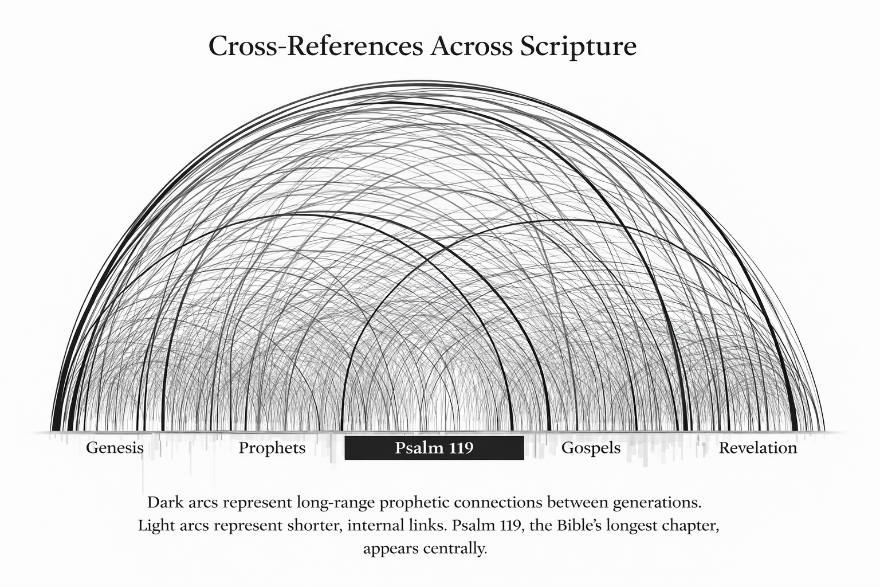
The arcs stretch from the earliest pages of Genesis to the final words of Revelation, reminding us that the Bible is not a collection of scattered writings, but one unfolding story—God re-establishing His kingdom and choosing to work through mankind to accomplish it.
At the center of this rainbow lies a long, light-gray bar representing Psalm 119, the Bible’s longest chapter. Its 176 verses, divided into 22 sections for each letter of the Hebrew alphabet, symbolize completeness. The psalmist’s use of the entire alphabet declares that God’s Word is whole, comprehensive, and sufficient for every part of life.
The colors of the arcs show how far apart the connected passages are, and they remind us of something astonishing: an ancient prophecy in one book finds its fulfillment centuries later in another. For example, Isaiah’s vision of the Suffering Servant—“He was pierced for our transgressions, He was crushed for our iniquities” (Isaiah 53:5)—finds its fulfillment in the Gospels’ account of Jesus’ crucifixion. This is only one of thousands of connections, all pointing us to Christ, the center of the story.
What might seem like 40 authors scattered over 1,545 years is revealed to be something much greater: one divine Author weaving a single, unified narrative. The rainbow of Scripture does not simply decorate the page—it reveals the faithfulness of God, the harmony of His Word, and the glory of His kingdom breaking into history through Jesus Christ.
Another image takes this truth even further by focusing on the Psalms and their relationship to the New Testament. Instead of isolated songs and prayers, the Psalms are shown to be woven directly into the life and ministry of Jesus and echoed in the writings of the apostles.
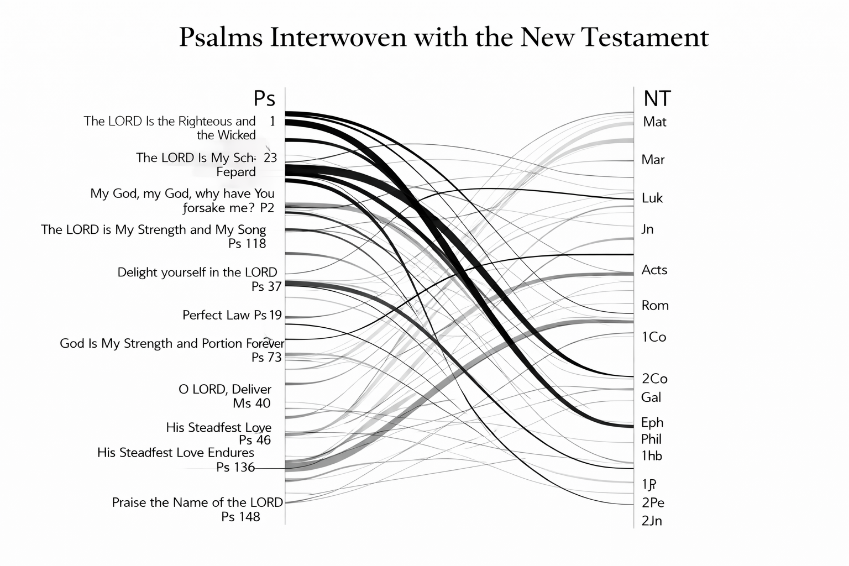
Consider Psalm 22, which begins: “My God, my God, why have You forsaken me?” David first voiced these words in anguish. Centuries later, Jesus spoke them from the cross (Matthew 27:46), fulfilling them in a way David himself could never have imagined. What began as lament became prophecy, brought to completion in Christ’s suffering and triumph.
When we see these connections drawn out visually, we begin to understand something extraordinary: Scripture speaks with one voice across more than 1,500 years of history, through 40 different authors from radically different backgrounds. Normally, such diversity would fracture into competing stories and conflicting perspectives. But the Bible holds together with one unified theme: the story of God’s kingdom, humanity’s redemption, and the reign of Christ.
Empires rose and fell during the time the Bible was being written. Languages changed, cultures evolved, and worldviews shifted. Yet the message of Scripture never broke apart. Instead, it held together with a guiding unity that transcends human ability. Its consistency is not only unusual — it is miraculous.
This continuity is not just literary; it is theological. If the Bible were simply a human work, we would expect contradictions and competing ideas. Instead, it unfolds seamlessly: creation, fall, redemption through Christ, and the promised restoration of all things.
Together, these images — the rainbow of Scripture and the web connecting Psalms to the New Testament — reveal more than just data points. They testify to the divine authorship of the Bible. Forty human authors across fifteen centuries could not have orchestrated such harmony. Only one divine Author could weave this story: God Himself, revealing His plan through His Word and bringing it to fulfillment in His Son.
The Bible is not just connected; it is alive, speaking with a single voice, telling one story from Genesis to Revelation: the story of God’s kingdom, restored through Christ, into which we are invited.
Why the Bible is Relevant to You
Self-help literature has gained immense popularity in recent decades, and many influential authors openly acknowledge that their wisdom is rooted in the truths of Scripture.
Dale Carnegie, author of How to Win Friends and Influence People, sold more than 30 million copies of his book and credited much of his insight to what he called “the great spiritual truths that all churches teach.”¹ His widely adopted principles—humility, empathy, restraint, encouragement—echo teachings found in Scripture.
Stephen Covey’s The 7 Habits of Highly Effective People, translated into dozens of languages and read by millions worldwide, was shaped by his daily meditation on Scripture. Covey viewed the Bible not as an abstract religious text, but as the foundation of his value system and leadership philosophy.
The same pattern appears elsewhere. Rick Warren’s The Purpose Driven Life and Dave Ramsey’s financial principles are explicitly grounded in biblical teaching. Warren’s work has sold tens of millions of copies, and Ramsey’s approach to stewardship has reshaped how families think about debt, discipline, and responsibility.
Even in the world of management theory, Scripture’s influence is evident. Peter Drucker—often called the father of modern management—acknowledged that his Christian faith shaped the principles he taught.⁴ Concepts such as stewardship, responsibility, service-oriented leadership, and accountability are not modern inventions; they are deeply biblical ideas.
The point is not that these leaders replaced Scripture. It is that they drew from it.
What millions embrace today as “best practices” in leadership, relationships, finance, and personal growth often reflects principles that have been preserved in the Bible for thousands of years.
The Bible is not merely a devotional text. It addresses how humans flourish, how authority should function, how responsibility should be carried, and how relationships should be ordered. Its influence is woven into modern thought more deeply than many realize.
But Scripture does more than improve productivity or strengthen leadership. It points beyond techniques and habits to the One who defines truth itself. It speaks not only to success, but to meaning. Not only to discipline, but to redemption.
In a rapidly shifting world, the Bible remains uniquely stable—offering not just strategies for living well, but a foundation for understanding reality, identity, and hope.
If God Has Spoken
Chapter 4 established who you are: an image-bearer, created by God.
This chapter answers the next necessary question: Has that God actually spoken—and can we trust what He said?
The evidence is not thin. It is overwhelming.
The New Testament is not fragile. It is reinforced.
When compared to other ancient works—Aristotle, Plato and Herodotus—the manuscript support is not comparable. It is exponentially greater.
If Scripture were unreliable, Christianity collapses.
But if Scripture is reliable—as the evidence strongly supports—then its claims demand a response.
Because the Bible does not merely inform you—it confronts you.
And it anchors those claims in a person—Jesus Christ.
If God has spoken—and the evidence says He has—then the most important question is no longer about textual variants.
It is about a personal relationship with Christ.
Because the reliability of God’s Word is not merely a scholarly conclusion.
It is the foundation upon which your identity, your morality, your hope, and your eternity stand.
And if that foundation is secure—everything changes.
Chapter 5: Summary
This chapter asks a critical question: Has God truly spoken—and can we trust what He has said?
If identity is grounded in God, then it must also be grounded in something stable. Scripture claims to be that foundation, but its reliability must be examined, not assumed. When it is, the evidence is striking. The New Testament is supported by an extraordinary number of manuscripts, preserved with transparency, and tested through centuries of careful study. Instead of weakening under scrutiny, it proves remarkably stable.
This reliability is not only textual—it is historical. The Bible stands apart from other ancient writings in both the volume of evidence and the consistency of its message. It is not a fragile tradition passed down blindly, but a record examined, compared, and preserved with precision.
At the same time, the Bible is unique in its unity. Written over more than a thousand years by many authors from different backgrounds, it tells one consistent story—pointing to God’s kingdom and fulfilled in Jesus Christ. That continuity is not easily explained by human effort alone.
The question, then, is not simply whether the Bible exists, but whether it can be trusted. And if it can be trusted, its message cannot be ignored. Scripture does not merely offer ideas—it makes claims about reality, about who you are, and about what God has done through Christ.
In the end, the issue becomes personal. If God has spoken, then His Word carries authority. And if His Word is reliable, then it forms the foundation for everything that follows—your identity, your understanding of truth, and your relationship with Him.
What would you like Mike to address?
Ask about identity, a Scripture passage, manuscript evidence, the personal nature of God, or something you think deserves a deeper explanation.
This is only one part of the story.
Black Holes and Other Works of God continues from identity and the reliability of Scripture into how God reveals Himself, quantum energy, relativity, time dilation, black holes, and eternity.
Choose another question.
Return to the four starting points and continue with whatever interests you next.
Source material: Chapters 4, Who Am I?, and 5, The Reliability of God’s Word, from the second edition of Black Holes and Other Works of God: God Seen. Everything Changes.