
“then the dust will return to the earth as it was, and the spirit will return to God who gave it.”Ecclesiastes 12:7
What is God’s purpose?
God is not hidden behind creation. He has spoken through every physical law, every boundary, and every beautiful pattern. Nothing is accidental.
If God is the Creator, then the cosmos is far more than random events or cosmic coincidence. It is an intentional act. And every intentional act flows from purpose.
This makes the question deeply personal:
What is God saying about why we are here?
Cause and Effect—Time and Eternity
Isaac Newton famously observed that every action produces a corresponding reaction. At the deepest level, the universe itself reflects this larger principle. We often refer to it as “cause and effect”.
If you walk along a deserted beach and see a fresh footprint in the sand, you do not assume the sand arranged itself that way. You conclude someone stepped there. The footprint began to exist—therefore, something caused it.
Why is this important to you?
Because for the universe to exist, there must be a cause. Something cannot come from nothing. And since you are part of the universe, you have a vested interest in its origin.
Consider the First Law of Thermodynamics—energy cannot be created or destroyed; it can only change forms.
That law of physics has very dramatic implications.
- All the energy in the universe had to come from a source outside itself.
- All of the energy in the universe today has existed from the beginning.
- Our universe is contained so that none of the energy is either lost or added to. One might think of the universe as a giant snow globe.
If the universe and its energy had a beginning, then the source of that beginning must lie beyond the physical system itself.
Theoretical physicist Stephen Hawking acknowledged the difficulty of explaining a beginning without something beyond the universe when he wrote:
“In an unchanging universe, a beginning in time is something that has to be imposed by some being outside the universe.”
That conclusion points toward the necessity of a cause beyond space, time, matter, and energy itself. Scripture identifies that cause as God—the eternal Creator who spoke all things into existence.
Understanding Eternity
Eternity is so vast that most people throw up their hands and say, “Nobody can really understand that.” And they’re right. We cannot fully comprehend eternity any more than a goldfish can comprehend the ocean.
But we can glimpse it.
Imagine the past, present, and future lined up on a single timeline.
Got that image in your mind?
Now ask yourself: How big is the future?
According to Scripture, the future stretches into eternity—limitless and unending.
How big is the past?
From our perspective, it stretches back to the beginning of the universe—however far that may be. To us, it feels unimaginably vast.
Both the past and the future are effectively infinite from our limited human viewpoint.
Now comes the most important question:
How big is the present?
Pause for a moment and think about it.
The instant you speak a word, that moment is already gone—pushed into the past.
By the time you become aware of a thought, that moment has already slipped away.
So how large is the present?
It is infinitely small.
The present exists, yet it is so fleeting we cannot grasp or hold it. We stand balanced on a razor-thin line between two infinities: an immeasurable past behind us and an immeasurable future ahead of us. Our entire lives are lived on a point so small it cannot even be measured.
Here is the striking implication:
If something as infinitely small as the present can exist, why is it so difficult to believe that Someone infinitely greater than time can exist?
Perhaps the greatest limitation is not that God is beyond reality—but that we are trapped inside only a tiny slice of it.
God does not merely pass through time.
He transcends it.
He is Eternal.
And if God truly exists beyond time itself, then creation is not merely an event buried somewhere in the distant past. It is the moment the Author of eternity spoke the universe into existence.
This naturally prompts a deeper consideration:
What would we expect to see if an eternal God created a physical universe?
For centuries, people assumed science and Scripture stood in opposition. Yet the deeper we peer into the structure of reality, the more fascinating the opening words of Genesis become.
Bridging Science and Scripture
“The earth was formless and void, and darkness was over the surface of the deep, and the Spirit of God was moving over the surface of the waters. Then God said, "Let there be light"; and there was light.”Genesis 1:2-3 NASB
Some may question how the Genesis account aligns with modern physics. A literal interpretation need not conflict with scientific discovery; instead, it can complement it. Genesis 1:3 states, 'Then God said, “Let there be light”; and there was light.'
This command to create light aligns with modern cosmology, where light (photons) and energy form the foundation of all matter.
Faith and science are partners in revealing the Creator’s glory—sometimes in the most unexpected places, like the spark that begins every human life.
The Spark of Life: Where Science meets Creation
Our universe began with a flash of light (Gen 1:3).
You too began with a flash of light. Scientists at Northwestern University captured this moment on film: at the instant a human sperm fertilizes an egg, a brilliant burst of zinc sparks erupts. The light explodes for about 20 seconds, then gradually fades over the next minute. In that brief window, two half-cells (meiotic) merge into one complete cell (mitotic) with a unique full set of DNA—creating a new human being distinct from both parents.
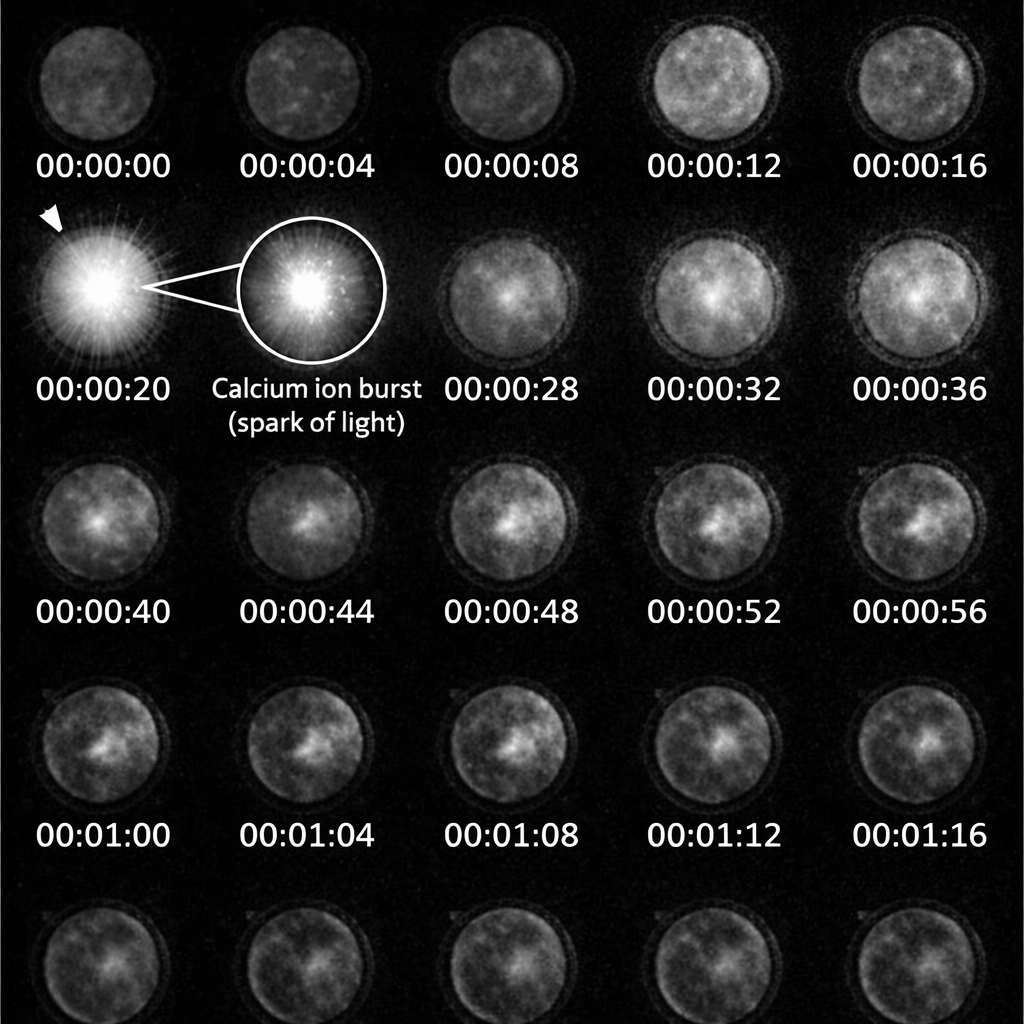
The brilliant spark that begins every human life mirrors the light that birthed the cosmos. Yet neither exists in a vacuum.
To understand their shared purpose, we must step back and see the larger stage: not just one physical universe, but two intertwined realms—Heaven and Earth.
The Two Realms: Heaven and Earth
That brilliant spark at the beginning of every human life does not happen in isolation. If both the universe and each person begin with purposeful light, they must belong to a larger story—one that existed long before our physical world.
Our expanding universe naturally raises big questions: What is it expanding into? Is there only one universe? Scripture gives us the answer by revealing two distinct realms: the material universe we inhabit and the eternal Kingdom of Heaven that preceded it.
Before the physical cosmos came into being, God existed eternally, outside of time and space.
“Before the mountains were born or You gave birth to the earth and the world, even from everlasting to everlasting, You are God.” (Psalm 90:2 NASB) “In the beginning was the Word, and the Word was with God, and the Word was God. He was in the beginning with God. All things came into being through Him…” (John 1:1-3 NASB) “In the beginning God created the heavens and the earth.” (Genesis 1:1 NASB)
These verses show that God’s heavenly realm is not part of the created universe—it transcends it.
Jesus reinforced this dual reality throughout His teaching. Made in God’s image, human beings are uniquely designed to bridge both realms: we live as physical creatures on Earth while carrying a spiritual awareness of Heaven.
This is why Jesus taught His disciples to pray:
“Our Father in heaven, hallowed be Your name. Your kingdom come. Your will be done, on earth as it is in heaven… For Yours is the kingdom and the power and the glory forever. Amen.”Matthew 6:9-13 NASB
Notice how the Lord’s Prayer—known by heart to millions—both begins and ends with the Kingdom.
Jesus placed the Kingdom at the very center of prayer because it is at the center of God’s plan. The prayer is not just a request for daily bread or protection; it is a declaration that Heaven’s reality should break into Earth’s story.
This dual reality sets the stage for the central drama of Scripture: a cosmic conflict over who has the right to rule.
Take the complete reading guide with you.
Download the complete Why Are We Here? reading guide as a PDF and receive future articles on creation, purpose, and the Kingdom of God.
Why Did God Create this Universe?
If creation has purpose, then we must ask the deeper question: Why did God create this universe at all?
Many believers would answer that the Bible’s central theme is the salvation of mankind. That is true—but only partly so. The Bible’s overarching theme is the restoration of God’s Kingdom in the face of rebellion.
Before this world existed, perfect peace and unity filled God’s eternal Kingdom. Angels worshipped and served Him without conflict.
Yet one powerful angelic being, described as perfect in beauty and wisdom, used the freedom of choice God had given him and allowed pride to rise in his heart. He sought to usurp God’s throne and establish his own rule (Isaiah 14:12-14; Ezekiel 28:12-15).
Other angels joined him in this rebellion. This act fractured the heavenly realm and introduced a false kingdom in opposition to God’s rightful authority.
Because the angels exercised their God-given ability to choose, their decision was final. Fallen angels remain under judgment with no plan of redemption. In contrast, God created humanity with both the freedom to choose and the extraordinary offer of redemption through faith in Christ.
As a result, God created the heavens and the earth—a new stage where the question of sovereignty would be settled. Earth became the battleground. Satan and his followers were cast down here (Revelation 12:7-9), and humanity was introduced as a new order of beings made in God’s own image.
We were commissioned to rule over the earth as God’s representatives:
“Then God said, ‘Let Us make man in Our image, according to Our likeness; and let them rule…’” (Genesis 1:26 NASB)“ Yet You have made him a little lower than God, and You crown him with glory and majesty! You make him to rule over the works of Your hands…” (Psalm 8:5-6 NASB)
But we know the story: humanity joined the rebellion through Adam’s fall. The rightful rule God intended for us was lost—until Jesus, the perfect God-man, succeeded where mankind had failed.
This is why Jesus began His public ministry proclaiming the Kingdom of God and taught us to pray, “Your kingdom come.”
The Lord’s Prayer is not a side note; it is a direct echo of the Bible’s central plot line. God is restoring what was broken.
The conflict will reach its climax when Satan’s false kingdom is fully defeated. The covenants will be fulfilled, the earth renewed, and God’s eternal Kingdom established without rival.
“Then I saw a new heaven and a new earth…” (Revelation 21:1) At that day, “every knee will bow… and every tongue will confess that Jesus Christ is Lord, to the glory of God the Father” (Philippians 2:9-11 NASB).
The same God who said “Let there be light” at the dawn of creation is guiding history toward this glorious restoration.
The spark that began the universe and the spark that begins each human life are not random. They are invitations—calling us to align our lives with the Kingdom that will ultimately prevail. This is the story we are living in. This is why we were created.
Finding Clarity in a Confusing World
In a world that often feels noisy and uncertain, it’s easy to wonder why so many people struggle to see the clear, beautiful purpose we’ve been talking about.
Many today have grown up hearing that the universe is an accident, that Scripture can’t be trusted, or that God is distant and uninvolved. Secular voices dismiss the covenants that reveal God’s loving plan to restore and bless the whole earth.
Yet none of this surprises our Father. He knows the confusion, and He has never left us without light.
Even in the midst of skepticism, God’s truth still shines. He reminds us:
“For My thoughts are not your thoughts, nor are your ways My ways,” declares the Lord. “For as the heavens are higher than the earth, so are My ways higher than your ways and My thoughts than your thoughts.” (Isaiah 55:8-9)
The same God who made the covenants with Abraham and promised a New Covenant of forgiveness is still faithfully working to bless all nations and restore what was broken. His plans have not failed — they are unfolding, right on schedule.
Yes, there is an enemy who loves to stir up confusion. Satan’s ancient rebellion continues as he tries to blind eyes and twist truth (2 Corinthians 4:4; Revelation 12:9). But his power is limited, and his defeat is certain. He cannot stop the light that broke into the universe, the light that sparkles at the beginning of every new life, or the greater Light who is Jesus Christ.
That is why Scripture gives us such tender, hope-filled invitations:
“Trust in the Lord with all your heart, and do not lean on your own understanding. In all your ways acknowledge Him, and He will make your paths straight.” (Proverbs 3:5-6) “But seek first His kingdom and His righteousness, and all these things will be provided to you.” (Matthew 6:33) “Jesus said to him, ‘I am the way, and the truth, and the life; no one comes to the Father except through Me.’” (John 14:6)
Clarity is not something we have to manufacture. It comes as a gift when we simply turn our hearts toward the One who spoke light into darkness.
The same Creator who formed the mountains, filled the oceans, and kindled the spark of life in you is patiently waiting to reveal more of Himself. The more we open our eyes to His creation and open our hearts to His Word, the more the fog lifts and the beauty of His Kingdom comes into focus.
You don’t have to have all the answers today. You only need a willing heart. And that is something our gracious Father delights to meet with open arms.
Knowing God Through His Creation
In Genesis, quantum energy was transformed into increasingly complex forms of atoms and molecules until human life was created.
From the Christian perspective, comprehending quantum energy becomes pivotal in understanding our universe and the divine hand behind it all.
There is an indisputable truth about God’s existence. Why do I say the truth of God’s existence is indisputable?
Because the mere act of looking at the majesty of great mountains, vast oceans, and towering redwoods attest to His existence.
All we have to do is open our eyes and see the world that surrounds us. The sky and the trees, the sun and the stars, the ocean and the land, all declare His existence.
This is called God’s “natural revelation” because He reveals Himself through nature. God has taken the first step in establishing a relationship with us by revealing Himself through His creation, and we must take the next step in recognizing Him as the Creator.
You Have a Purpose
In this chapter we have begun to follow the evidence of design—from the first light of creation to the spark of light at conception, from the reality of heaven and earth to the conflict of kingdoms that explains the moral tension of history.
The universe is not only made—it has meaning.
God’s design does more than prove His existence. It reveals His intention.
And that intention is not vague. Scripture presents a unified story.
God’s kingdom is real, His sovereignty is rightful, and His purpose is to restore what rebellion fractured.
That is why confusion is so dangerous—it does not merely distort ideas; it obscures the very plan that gives life meaning.
The answer to confusion is not cynicism—it is an open mind.
If creation is designed, then you are not lost in it. You are placed within it—called to see, to understand, and to seek the King whose world this is.
You Were Not an Afterthought
Look at the arc of what we have seen.
Light bursts into existence at the dawn of the universe.
Light flashes at the beginning of human life.
Heaven precedes earth.
A kingdom precedes history.
A conflict precedes your birth.
You did not enter a random world.
You entered a story already in motion.
Before you ever drew breath, a question was already echoing through creation:
Who has the right to rule?
Satan challenged it.
Angels chose sides.
Earth became the arena.
Humanity was given the power of allegiance.
And then you were born.
Not as an accident of chemistry.
Not as an unintended byproduct of energy.
But as an image-bearer placed inside a kingdom conflict with the capacity to choose.
This is why creation matters.
If the universe is intentional, then you are intentional.
If the kingdom is real, then your life has context.
If Christ will ultimately reign, then history is not accidental—it is unfolding.
Confusion clouds this truth. Culture distorts it. Skepticism questions it.
But the structure of reality still stands.
The heavens declare.
The cell ignites.
The covenants unfold.
The King reigns.
You are not drifting through meaningless space.
You are living inside a deliberate design.
And design always implies purpose.
We are no longer simply asking whether God created.
The deeper issue becomes:
Will you keep an open mind and examine the kingdom you are already standing in?
Because when you see that creation is purposeful, you begin to see that you are too.
And that realization changes your worldview and how you live.
Chapter 2: Summary
This chapter begins with a simple but profound question—Why did God create at all?—and leads us on a journey from the wonders of creation to the heart of His eternal purpose.
We saw that the universe is not an accident. From the cause behind its beginning, to the razor-thin present caught between two infinities, to the brilliant flash of light at the dawn of creation and at the spark of every human life, everything bears the mark of intentional design. Faith and science join hands in declaring the glory of the Creator.
Scripture reveals the bigger story: before our physical world existed, God reigned in perfect peace in His eternal Kingdom. Rebellion fractured that peace, and this earth became the stage where the question of rightful rule would be answered. Humanity was lovingly placed in the middle of that story—not as bystanders, but as image-bearers with the freedom to choose allegiance and the breathtaking invitation to join God in restoring what was broken.
Even when confusion clouds our vision, God’s truth still shines. He patiently calls us to trust Him, seek His Kingdom first, and fix our eyes on Jesus—the One who is the Way, the Truth, and the Life.
You were never an afterthought.
You were born into a purposeful universe, inside a meaningful story, with a real part to play in God’s unfolding Kingdom. If creation is intentional, then so are you.
And that truth has the power to change how you see everything.
What would you like Mike to address?
Ask about an argument, a Scripture passage, a scientific connection, or something you think deserves a deeper explanation.
This is only one part of the story.
Black Holes and Other Works of God continues from purpose into authority, identity, the reliability of Scripture, quantum energy, relativity, time dilation, black holes, and eternity. If this exploration raised questions you want to follow further, the complete book is the next step.
Choose another question.
Return to the four starting points and continue with whatever interests you next.
Source material: Chapter 2, God's Purpose for Creation, from the second edition of Black Holes and Other Works of God: God Seen. Everything Changes.